Europe Datacenter Market Outlook : A Strategic Perspective To 2030
December 2025
$4599
Market Report
Report Summary
Europe’s datacenter market is set for strong growth through 2030, driven by AI adoption, cloud expansion, and energy transition. This report highlights investment potential, emerging hubs, power demand, and value-chain opportunities.
Europe Datacenter Market Outlook : A Strategic Perspective To 2030
The European datacentre market was valued at approximately US$47 Billion in 2024 and is forecast to expand to nearly US$97 Billion by 2030, reflecting its central role in enabling Europe’s digital and AI-led growth agenda. The International Monetary Fund estimates that the accelerating adoption of artificial intelligence could lift global GDP growth by an additional 0.5 percentage points annually between 2025 and 2030, contingent upon the timely and large-scale deployment of datacentre infrastructure.
Across major European economies, datacentres have already emerged as a material driver of investment, economic output, and productivity. In the Netherlands, the datacentre and cloud ecosystem accounts for nearly 20% of total foreign direct investment, making it the single largest contributor to FDI inflows. In Germany, datacentres generated an estimated US$ 12.16 billion in direct and indirect GDP contribution in 2024, a figure projected to more than double to approximately US $ 27 Billion by 2029.
Comparable trends are evident in the Nordics, where Norway’s datacentre sector contributed an estimated US $ 281 Million to the economy in 2023, delivering higher economic value per unit of electricity consumed than traditional power-intensive industries such as chemicals manufacturing.
In the UK, the government estimates that accelerated AI adoption could improve national productivity by 1.5 percentage points annually, translating into incremental economic value of approximately US$ 64.3 Billion per year over the next decade. Similarly, the Irish government has underscored the “indispensable” role of datacentres in sustaining national economic competitiveness and societal advancement.
USPs
First hand sector knowledge and inputs
Primary research inputs from F2F interviews with domain experts
Experts insights and market reviews taken into consideration Validated data and analysis Opportunity mapping and market sizing
Germinates from minds that think fresh to evolve path finding guide for all stake holders through quality information and analysis
Free query handling and analyst support for three months from the date of report procurement
Key Highlights
Europe’s datacenter market is projected to grow from ~US$47 billion in 2024 to nearly US$97 billion by 2030, driven by AI adoption, cloud expansion, and enterprise digitalization.
The European Union is expected to mobilize ~US$234 billion in AI-focused investments, significantly strengthening the business case for datacenter infrastructure.
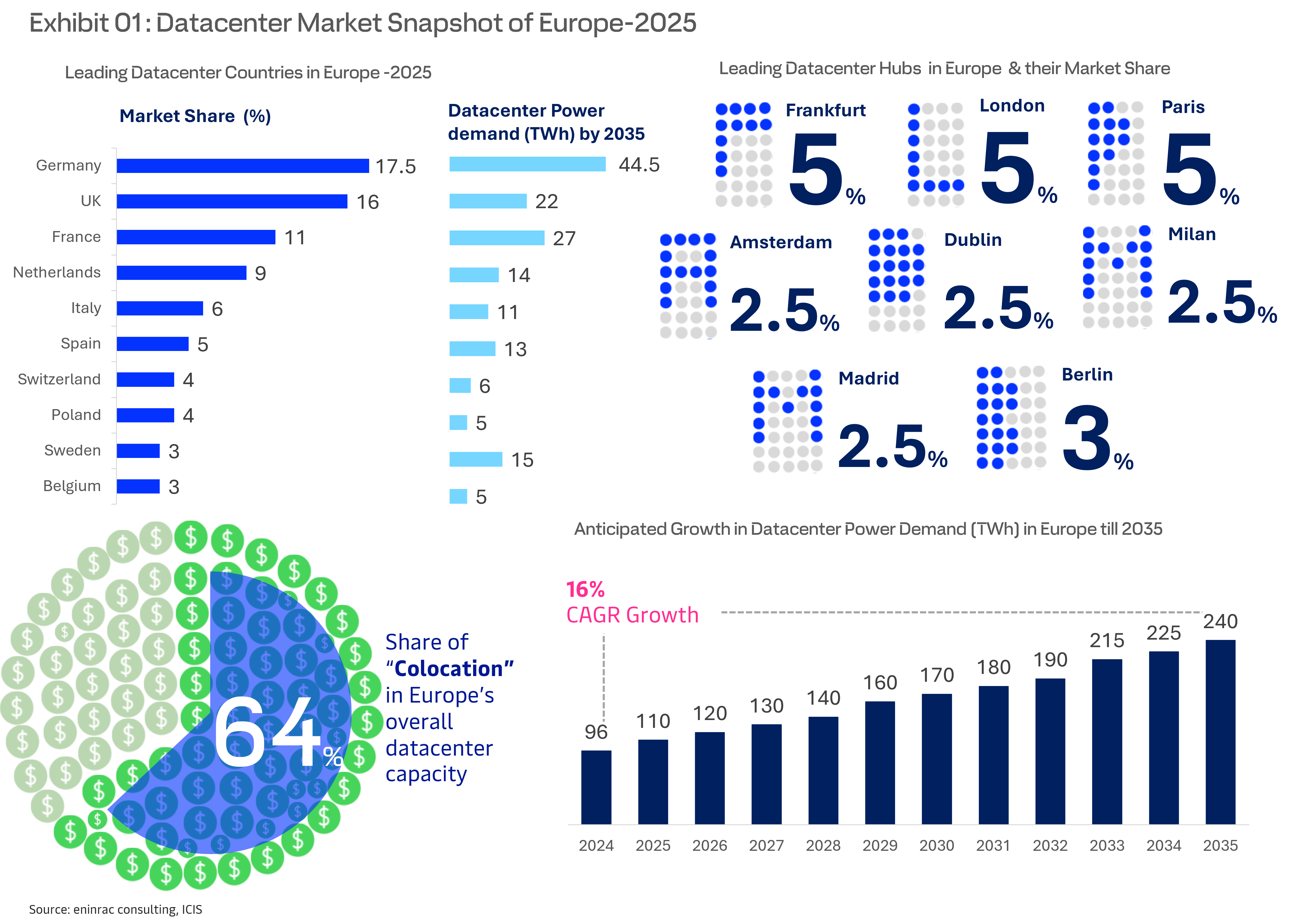
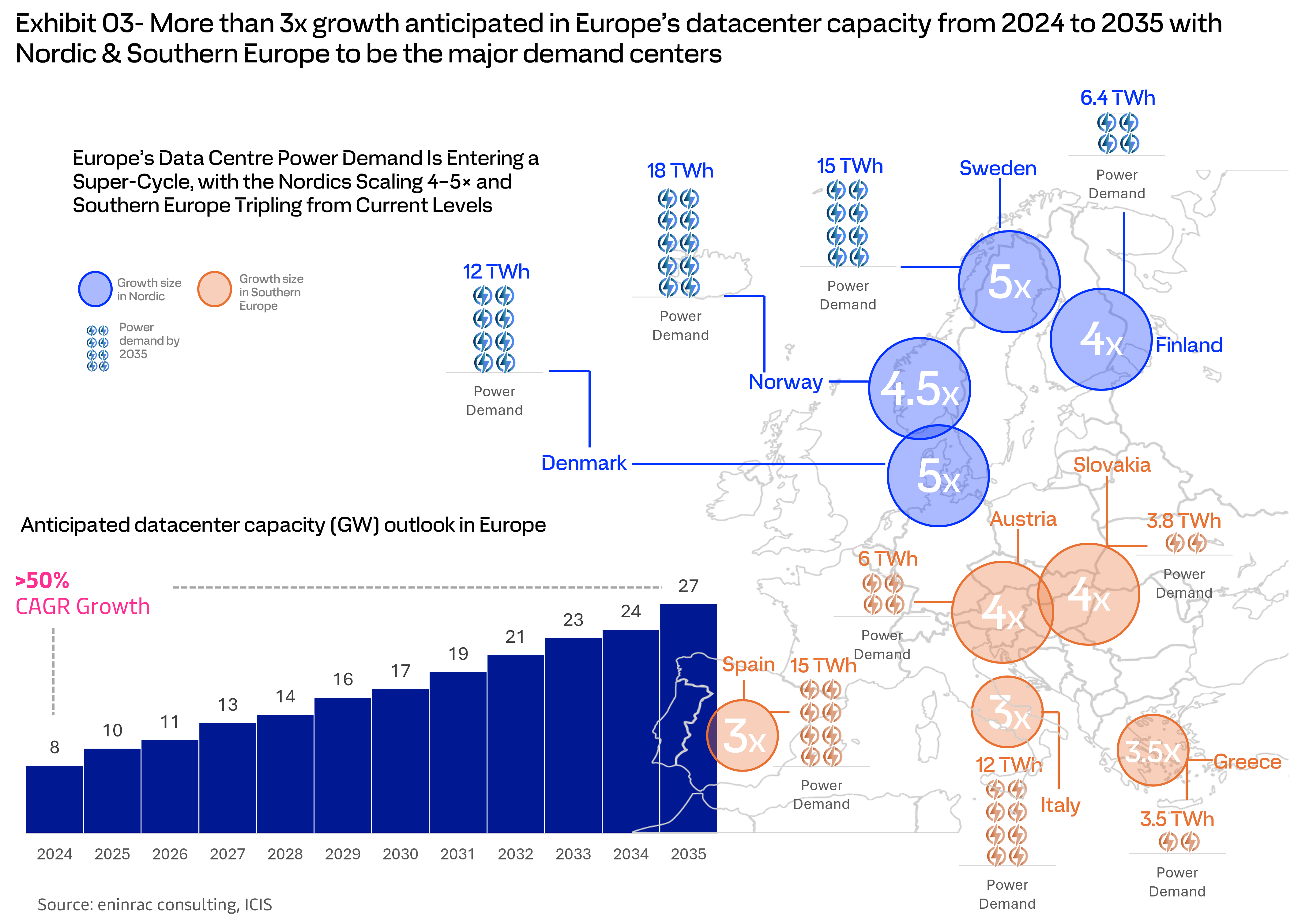
Datacenter capacity in Europe is forecast to more than triple between 2024 and 2035, with Nordic and Southern Europe emerging as major demand centers.
Power availability has become a critical constraint, delaying ~40% of datacenter projects, creating strong demand for grid upgrades, BESS, and on-site energy solutions.
Nordic countries offer a competitive advantage through low-cost green baseload power, long-term PPAs, and waste-heat monetization, improving project economics.
Southern Europe is emerging as the next wave of datacenter hubs, supported by hybrid solar-plus-storage solutions, grid reforms, and land availability.
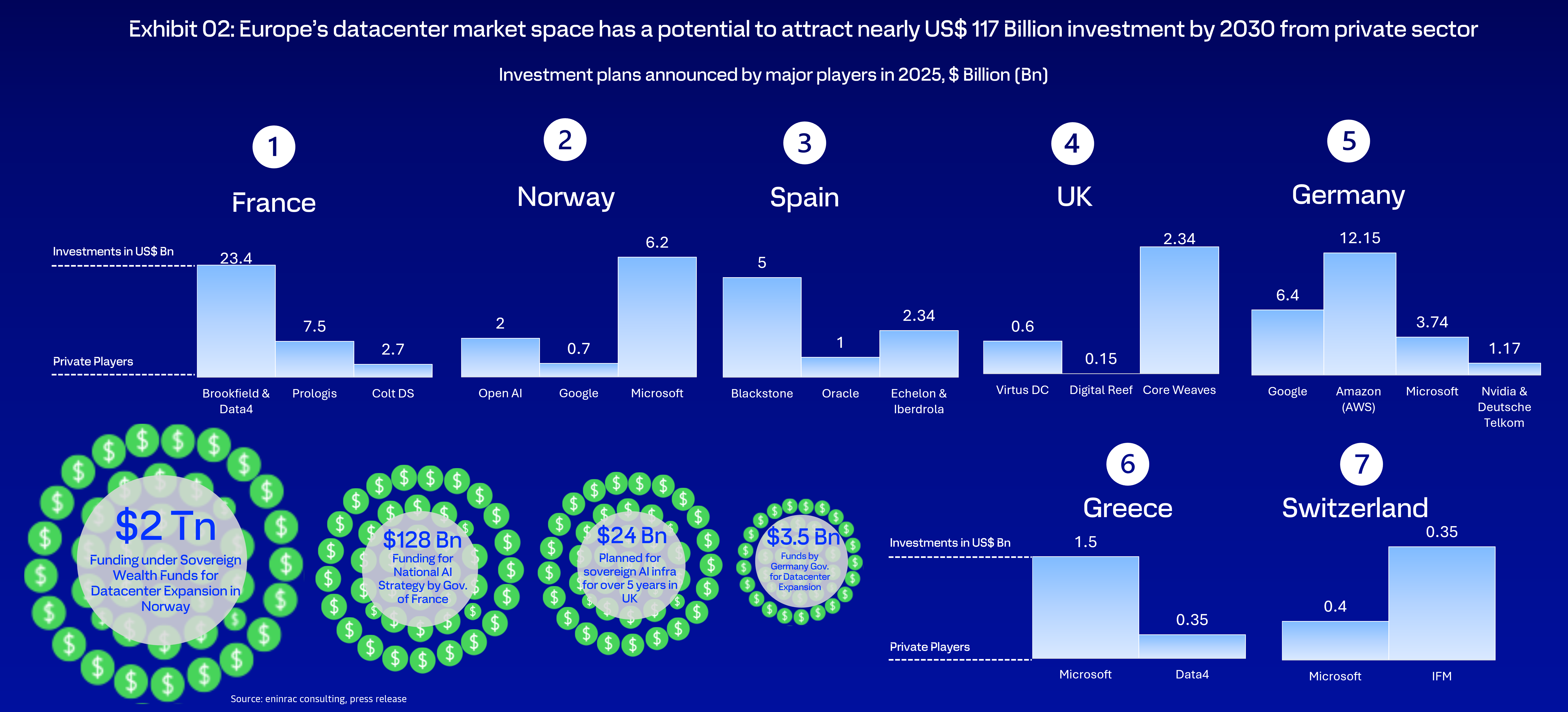
Europe’s datacenter market could attract ~US$117 billion in private sector investments by 2030, led by hyperscalers and colocation providers.
AI workloads are accelerating demand for high-density racks, liquid cooling technologies, and advanced HVAC systems, expanding the cooling market rapidly.
Datacenters are increasingly participating in flexibility and demand-response markets, unlocking new revenue streams for utilities and grid operators.
Growth is shifting beyond core FLAP-D markets to secondary locations where land is cheaper and renewable energy access is stronger.
Report Insights
Europe’s datacenter market is entering a decisive growth phase, underpinned by accelerated AI adoption, expanding cloud ecosystems, and rising enterprise digitalization. With market value expected to nearly double by 2030, datacenters are emerging as a core pillar of Europe’s digital and economic infrastructure rather than a niche real estate asset.
A structural shift is underway as power availability, grid capacity, and sustainability considerations increasingly dictate site selection and investment returns. Traditional FLAP-D markets continue to anchor demand but face mounting constraints related to land scarcity and grid congestion, pushing developers toward secondary markets in the Nordics and Southern Europe where renewable energy access and policy support are stronger.
The convergence of AI-driven high-density computing and energy transition goals is reshaping the value chain. Demand is intensifying for grid upgrades, battery energy storage systems, advanced cooling technologies, and flexible power solutions, creating substantial opportunities for utilities, EPC players, and energy solution providers. Datacenters are also evolving into active grid participants, monetizing flexibility and demand-response capabilities.
Overall, Europe’s datacenter landscape presents a multi-year, capital-intensive opportunity characterized by strong private investment momentum, regulatory alignment with green infrastructure, and expanding cross-sector collaboration between digital infrastructure, power markets, and renewable energy ecosystems.
Must Buy For
Data Centre Developers (Hyperscale, Colocation, and Edge)
Government Agencies & Regulatory Authorities (Digital Infrastructure, Power, Urban Development)
Investment Banks & Infrastructure Funds
Private Equity & Venture Capital Investors in Digital Infrastructure
Export Credit Agencies (ECAs) & Development Finance Institutions
Technology Solution Providers (AI, Automation, and DCIM Platforms)
Companies Mentioned
Digital Realty Datacenter Atlas Edge Datacenter Cloud HQ Datacenter nLighten Datacenter Ark Datacenter Equinix Datacenter Global Switch Datacenter Iron Mountain Cyrus One Virtus Datacenter Global Switch Stack Infrastructure
Report FAQs
What is the growth outlook for Europe’s datacenter market by 2030?
Europe’s datacenter market is expected to grow from around US$47 billion in 2024 to nearly US$97 billion by 2030, driven by AI adoption, cloud expansion, and enterprise digital transformation across major EU economies.
Which regions are emerging as high-ROI datacenter hubs in Europe?
Beyond traditional FLAP-D markets (Frankfurt, London, Amsterdam, Paris, Dublin), Nordic countries and Southern Europe are emerging as high-ROI hubs due to lower power costs, renewable energy availability, and better land access.
How is artificial intelligence impacting datacenter demand in Europe?
AI workloads are significantly increasing datacenter capacity, power demand, and cooling requirements. High-density racks, advanced cooling solutions, and flexible power infrastructure are becoming critical to support AI-driven growth.
What opportunities does Europe’s datacenter growth create for power utilities and grid operators?
Datacenter expansion opens major opportunities for grid upgrades, renewable integration, BESS deployment, microgrids, and demand-response services, enabling utilities to unlock long-term, high-margin revenue streams.
Complete the form to get in touch with our sales team to see our Visionboard platform in action. We'll show you how you can use eninrac to build a culture of action of consistently hunting down and eliminating poor market research expriences across your companies line of business